A grounding sheet doesn't last forever. It also doesn't fail dramatically. It just slowly stops working as the conductive fibers age, until one day you realize the sheet you've been sleeping on hasn't been actually grounding you for months.
The trick is knowing when that's happened. Visual inspection won't tell you. The sheet looks identical at year three as it did at year one. You need to actually measure the conductivity to know whether the sheet is still functional or whether you've been quietly using expensive bedding.
Here's how to figure out when your sheet is genuinely past its useful life, what factors affect the timeline, and what to do when it's time for a new one.
The honest lifespan ranges by material
The expected lifespan varies significantly by what the conductive material is.
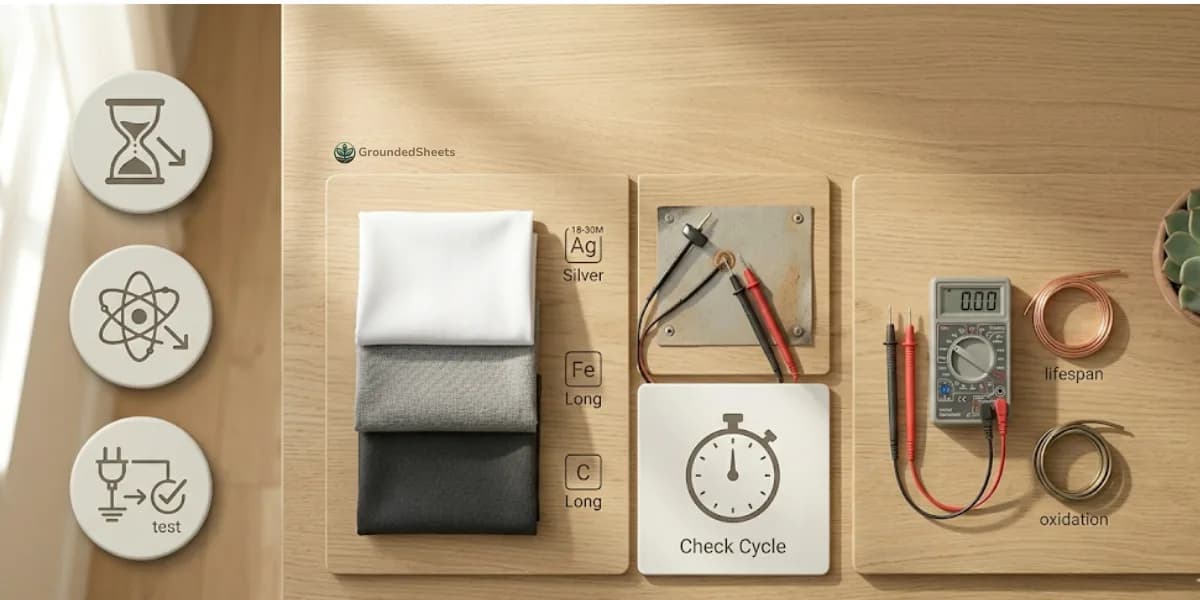
Silver-fiber cotton sheets are the most common type, and they're also the shortest-lived. Silver tarnishes over time as it oxidizes, especially during washing and from skin contact. A silver sheet's resistance climbs gradually from a starting value of 2-5 ohms up toward 20-30 ohms over its useful life.
A typical silver sheet, with reasonable care, lasts 18 to 30 months. Aggressive washing with the wrong detergent shortens this toward 12 months. Gentle care with proper detergent and air drying extends it toward 36 months. Premium silver sheets with higher silver content (7-8% by weight) last toward the upper end. Budget silver sheets at lower content (2-3%) lose conductivity faster.
Stainless steel sheets last meaningfully longer than silver. Stainless doesn't tarnish in any practically relevant way. The fibers themselves don't degrade chemically, just mechanically. A stainless steel sheet typically lasts 30 to 48 months, often longer if construction is solid. The wear comes from physical breakdown of the conductive thread under repeated washing and use, not from oxidation.
Carbon-based sheets are similar to stainless in terms of chemical durability. Carbon doesn't oxidize meaningfully under normal use conditions. Lifespan typically runs 30 to 48 months, sometimes longer. The factor that limits carbon sheet life is mechanical wear of the cotton matrix and the eventual physical degradation of the conductive coating on the synthetic threads.
These ranges assume reasonable use: weekly washing, gentle detergent, normal sleep wear-and-tear. Heavy users (multiple beds, frequent moves, kids or pets that wear bedding faster) should expect numbers at the lower end.
What actually wears out a grounding sheet
Three categories of wear matter.
Conductive fiber degradation is the primary factor for silver sheets. Tarnishing increases resistance, which eventually pushes the sheet past the functional range. Carbon and stainless sheets don't experience this kind of chemical aging.
Physical fiber breakage affects all sheet types. The conductive threads in any grounding sheet are more brittle than the cotton they're woven through. Repeated stretching during use, washing, and drying causes individual fibers to break. Initially this creates small dead zones in the conductive grid. Over time these dead zones grow.
Cotton matrix breakdown is the wear that limits lifespan for sheets where the conductive material itself is durable. The cotton fibers wear out, the weave loosens, the sheet thins, and eventually the structural integrity fails even though the conductive material is still intact.
For silver sheets, conductive degradation usually fails first, around the 24-month mark with average care. For stainless and carbon sheets, the cotton wears out before the conductive material does, which is why these sheets often last longer.
How to tell if your sheet is still working
The visual inspection approach doesn't work. Sheets that have lost most of their conductivity still look identical to new sheets.
The reliable test is electrical. Use a multimeter to measure resistance across the conductive fabric.
Set your multimeter to ohms (Ω) on the lowest range or auto-ranging. Touch one probe to the snap connector on the sheet. Touch the other probe to a point on the conductive fabric, ideally far from the snap (a far corner is best). The reading is the resistance from that corner to the snap.
A new sheet reads 2-5 ohms (silver) or 5-15 ohms (stainless or carbon). A well-maintained sheet at the 12-month mark typically reads slightly higher: 5-10 ohms (silver) or 8-18 ohms (stainless/carbon). At 24 months with good care, expect 8-15 ohms (silver) or 10-25 ohms (stainless/carbon).
The functional cutoff is around 25 ohms. Above that, the grounding effect is significantly reduced, even though it's not zero. By the time a sheet reads 40-50 ohms across the surface, it's effectively dead even though it still looks fine.
I'd recommend testing your sheet every three to six months once it's past the one-year mark. Three months apart for silver sheets (which age faster), six months apart for stainless or carbon. This catches the gradual decline before you've spent months sleeping on a sheet that isn't actually working.
What affects the timeline
Several factors push lifespan toward the shorter or longer end of the range.
Wash frequency. Weekly washing is gentler than washing every few days. Washing every two weeks is even gentler. Most users wash bedding weekly, which is fine. Washing more often than that ages the sheet faster.
Wash temperature. Cold water washing is significantly gentler than warm or hot water. Hot water especially accelerates silver tarnish.
Detergent choice. Free-and-clear detergent extends life. Standard detergent with optical brighteners shortens it. Bleach shortens it dramatically. Fabric softener kills conductivity within a few washes regardless of how good the underlying sheet is. what detergent is safe for grounding sheets
Drying method. Air drying is gentler than tumble drying. Low heat tumble drying is gentler than high heat. High heat shortens silver sheet life noticeably; less impact on carbon and stainless.
Sleep environment. Sweat and skin oil contact the conductive fabric even with bedding above the sheet. Hot sleepers who sweat more during the night age sheets slightly faster. Pets sleeping on the sheet accelerate physical wear from claws and shedding.
Hard water. Hard water with high mineral content deposits trace minerals on the conductive fibers, eventually reducing conductivity. A water softener at the home level eliminates this issue. Periodic vinegar rinse during washing partially mitigates it.
Build quality. A well-built sheet from a reputable brand lasts longer than a cheap white-label product, even at similar conductive percentages. The cotton weave quality and construction details affect both physical durability and how the sheet handles wash cycles.
A sheet treated well can last 30+ months. A sheet treated poorly can be dead at 12 months. The factor of two is real.
When to replace versus when to revive
If your sheet is testing at 15-25 ohms and still feels functional, it's not yet dead but is approaching the end. A few options exist for extending life slightly.
For silver sheets, a vinegar soak can temporarily restore some conductivity. Submerge the sheet in cold water with a cup of distilled white vinegar per gallon for 30-60 minutes, then rinse and air dry. The mild acid removes some of the silver oxide layer that's developed on the fibers. This isn't a permanent fix; you might get another two to four months of useful life from a treatment, and after two or three treatments the sheet usually doesn't respond anymore. vinegar soak method to restore grounding sheet conductivity
For stainless and carbon sheets, vinegar soaking doesn't help much. The conductivity decline in these materials is mechanical (broken fibers, worn cotton) rather than chemical, so chemical treatment doesn't restore function. When these sheets reach end of life, they're done.
Once a sheet is consistently testing above 25 ohms even after treatment, replacement is the right answer. You can't recover from that level of degradation, and continuing to use the sheet isn't actually grounding you.
What to do when it's time for a new sheet
A few suggestions when you're ready to replace.
Don't just throw the old sheet away. Donate it as a regular bedsheet. The grounding function is gone but the sheet still works as bedding.
If the brand and model worked well for you, buy the same one again. Brand consistency means the new sheet integrates with whatever cord routing and outlet setup you've already established.
If you've learned things during the lifetime of the old sheet (it was too thin, the cord was too short, the size was wrong), use the replacement as an opportunity to upgrade those specific issues without changing brands.
Consider whether your needs have changed. Maybe you started with a fitted sheet but you've realized a half-sheet would fit your life better. Maybe you're moving to a memory foam mattress and need a deep-pocket option. The replacement decision is a good time to reconsider the format. types of grounding sheets
A budgeting framework
Rough numbers for planning purposes:
Premium silver sheet at $200, lasting 30 months: $6.67 per month.
Mid-range silver sheet at $130, lasting 24 months: $5.42 per month.
Budget silver sheet at $90, lasting 18 months: $5.00 per month.
Premium stainless steel sheet at $180, lasting 40 months: $4.50 per month.
Budget carbon sheet at $90, lasting 36 months: $2.50 per month.
These are approximations, but they show that material choice affects cost-of-ownership more than upfront price. Budget carbon sheets often have the best cost-per-month, despite being the cheapest. Premium silver sheets are often the most expensive per month, despite the long lifespan. The marketing assumes premium pricing means better value. The actual numbers don't always agree. silver vs stainless steel grounding sheets
For someone planning their grounding sheet budget over years rather than per-purchase, the math suggests stainless steel or carbon sheets at mid-tier pricing as the durable, cost-effective choice. Silver makes sense if you specifically value the premium feel, not as a default.
The replacement question isn't really "how often do I need to replace this?" It's "am I getting my money's worth from this product?" When a sheet stops working, the answer becomes no, and replacement makes sense. Until then, no rush. Test every six months and replace when the test says it's time.