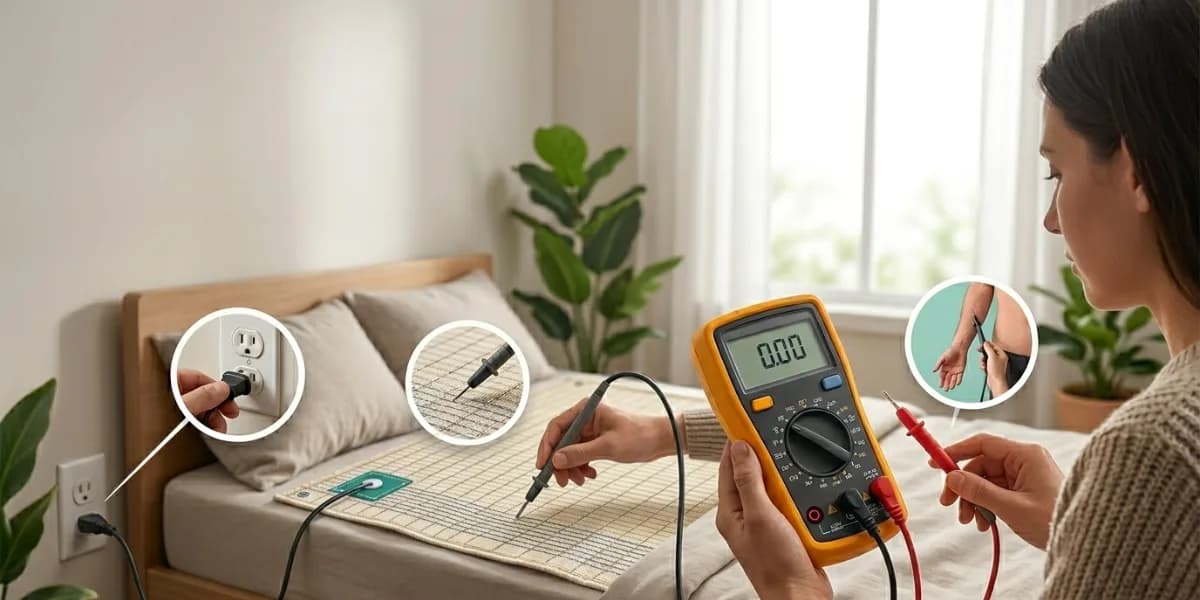
Most grounding sheets don't fail. Most outlets do.
I'll explain what I mean in a second, but this is the single most important thing to know before you spend twenty minutes testing anything. The sheet itself is almost always fine. When people say their grounding sheet isn't working, nine times out of ten they've plugged it into an outlet that's lying about being grounded, and the sheet is sitting there politely doing nothing.
So this guide walks you through three tests, in order. The first one takes two minutes and tells you if your outlet is even capable of grounding the sheet. The second one confirms the sheet is conductive. The third one measures whether sleeping on it actually drops your body voltage, which is the closest thing to a functional test that exists for this kind of product.
You need about fifteen dollars of tools and ten minutes. That's it.
What you'll need
A three-prong outlet tester. These cost around six to ten dollars at any hardware store, and they look like a plug with three colored lights on the back. (For the full walkthrough, see how to test if your outlet is grounded.) Klein Tools and Sperry both make fine ones.
A digital multimeter. You don't need a fancy one. A basic auto-ranging multimeter for fifteen to twenty dollars is more than enough. If you've already got one from a home project, it'll do the job.
Two alligator-clip test leads, or a multimeter that comes with them. Standard probe tips work too, they're just harder to hold in place for sixty seconds.
That's the entire kit. You don't need specialized grounding equipment despite what some brand websites will try to sell you.
Test 1: Is your outlet actually grounded
This is where you start. Always.
Plug the outlet tester into the wall outlet you're planning to use for your grounding sheet. Look at the light pattern on the back.
A properly grounded outlet shows two amber lights and no red light, or whatever pattern the tester's label says means "correct wiring." Every tester has the legend printed on it. If you see "open ground," "reverse polarity," or "hot/ground reversed," your outlet has a wiring problem and your grounding sheet will not work through it, no matter how expensive the sheet is.
This is the single most common reason people think their sheet is broken. Especially in older homes, especially in apartments where someone swapped a two-prong outlet for a three-prong without rewiring. The outlet looks modern. It accepts the plug. But the ground hole is connected to nothing.
If your outlet fails this test, you have three options. Have an electrician rewire it properly, which is the right long-term fix. Use a different outlet in the house that does pass the test (bathrooms and kitchens usually have GFCI-protected outlets that are more likely to be grounded correctly). Or install an exterior ground rod and run the sheet's cord to it directly, bypassing your home's wiring entirely. Most grounding brands sell rod kits for about thirty dollars. See installing a ground rod.
Don't move on until your outlet passes. Everything after this assumes you have a real ground.
Test 2: Is the sheet itself conductive
Now you check the sheet.
Set your multimeter to the resistance setting, usually marked with the omega symbol (Ω). If it's auto-ranging, you don't need to pick a scale. If it's not, start at the 200-ohm range.
Touch the two probe tips together. The meter should read close to zero, maybe 0.1 to 0.5 ohms depending on the probes. That's your baseline.
Now touch one probe to the snap connector on the sheet (the metal fastener where the cord clips in) and the other probe to any point on the conductive fabric itself. Move the second probe around to a few different spots, corners, center, edges.
A healthy grounding sheet will read somewhere between 1 and 10 ohms across the surface. A brand new sheet from a reputable manufacturer usually sits between 2 and 5 ohms. If you're getting readings above 20 ohms, the conductive fibers aren't making good contact with the snap. If you're getting "OL" or infinite resistance, something's broken, either a tear in the conductive weave or a bad connection at the snap.
Here's a quiet truth about this test. After 30 to 50 wash cycles, even a good silver sheet starts creeping up toward 15 or 20 ohms. That's normal aging. Anything under 25 is still functionally grounding you. Once you're past 50, the sheet is effectively dead even if it still looks fine.
Test 3: The body voltage test (the real one)
This is the test that actually tells you whether the whole system is doing its job. It's also the one that makes you feel like a mildly deranged electrician in your pajamas, which is part of the fun.
Set your multimeter to measure AC voltage, usually marked V with a wavy line (~) next to it. Pick the 2V or 20V range if you have to choose.
Plug one lead of the multimeter into the ground port of a working outlet. The easy way is to use an alligator clip attached to the center screw of an outlet face plate (which is connected to ground on most US outlets), or clip it to the ground pin of a separate plug you've disassembled. If that feels sketchy, most grounding brands sell a "body voltage tester" accessory that's essentially this setup packaged nicely for about twenty-five dollars.
Hold the other probe firmly against your bare skin, on your forearm or the back of your hand.
Stand in the middle of your bedroom with the lights on, phone nearby, lamp on, the usual sleeping environment. Watch the meter for about 30 seconds to let it settle.
In most bedrooms, you'll see something between 0.8 and 5 volts of AC. That's your body voltage, the induced voltage your body is carrying from all the AC fields around you. It's not dangerous. It's just there.
Now sit on your grounding sheet with the sheet plugged in. Keep the probe on your skin. Wait another 30 seconds.
If the sheet is working, the reading should drop dramatically, usually to below 0.1 volts. Often to essentially zero, within the noise floor of the meter. That drop, from a volt or two down to nearly nothing, is the functional proof that the sheet is doing exactly what it claims to do mechanically.
If the reading doesn't drop, something in the chain is broken. Go back to test 1 and test 2.
What a passing result actually means
I want to be careful here because this is where a lot of grounding content overreaches.
Passing all three tests proves one thing, and only one thing: your sheet is successfully connecting your body to earth ground, and reducing your induced body voltage to near zero. That's a measurable, repeatable, physical fact.
Whether that reduction in body voltage translates into better sleep, less inflammation, faster recovery, or any of the other claims you'll see on brand websites is a separate question. The research exists, it's suggestive in places, and it's also limited in scope and funding. I think it's worth reading for yourself and drawing your own conclusions rather than taking any single source as gospel.
What the test does rule out is the most frustrating failure mode: paying good money for a sheet that was never grounding you in the first place. If you can confirm the circuit is intact, you've done the part that's actually under your control.
How often to retest
I'd do the full three-test sequence once when the sheet is new, to establish your baseline. Then repeat test 2 (the sheet conductivity test) every couple of months, or after any wash cycle that seems rough. Retest test 3 (body voltage) if you ever move the bed, replace the cord, or change the outlet.
Honestly, the two-minute outlet test is the one I'd run any time you move or set up a grounding sheet in a new location. Outlets lie more often than sheets do.
When to trust a brand that won't show test data
The short answer: don't.
Any grounding sheet brand worth buying from will publish resistance specs, wash cycle data, and ideally a conductivity guarantee. If a brand's marketing is full of wellness imagery and empty of numbers, that's a signal. The good brands measure their own product and tell you the numbers. The not-so-good ones ask you to trust the vibes.
Fifteen dollars of tools and ten minutes is all it takes to check for yourself. I'd rather you spent that ten minutes than wondered for three months whether the $200 sheet on your bed is actually doing anything.
Do the outlet test first. Everything follows from that.
Need a grounding sheet that just works?
If you're still shopping, our top picks are the brands we trust to actually conduct and last.
See Our Top Picks →