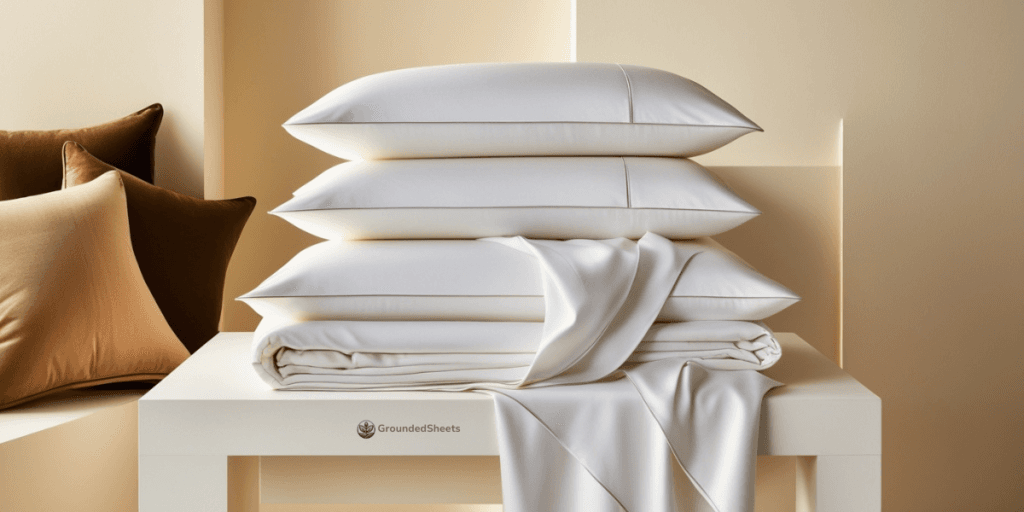
A grounding pillowcase is the smallest commitment in the grounding product family. It's also, in my honest opinion, the least useful purchase if you only buy one thing.
I want to lead with that because most articles on this topic are written by affiliate sites that won't say it. The pillowcase is great for upselling. It's a lower price point, it's easy to add to a cart alongside a sheet, and the marketing photos look cozy. But functionally it's the weakest member of the grounding lineup, and I think a lot of people who buy one would have been happier with a mat or a sheet instead.
That said, there are situations where a grounding pillowcase makes sense. Let me walk through both sides honestly so you can decide for yourself.
What a grounding pillowcase actually is
A grounding pillowcase looks like a regular pillowcase made of silver-fiber cotton or similar conductive fabric. The case slips over your existing pillow. A snap connector and cord plug into a grounded outlet, the same way a sheet does.
Your head and neck rest on the conductive surface during sleep. That's the contact point. Whatever earthing effect happens, happens through the relatively small area of skin that's in contact with the case at any given moment.
The conductive materials are the same ones used in sheets: silver-fiber cotton, sometimes carbon fabric, occasionally stainless steel blends. Construction is similar. The only meaningful difference is the form factor.
My honest case against pillowcases
Three things bug me about this product category.
Contact time is unreliable. Your head moves around at night. Even if you start the night with your face on the pillow, you'll roll, shift, lift your head, sleep partially face-down. The actual cumulative contact time with a grounding pillowcase is probably one to three hours per night for most sleepers. Compare to a grounding sheet, which maintains contact through your back or torso for the full sleep duration. It's not even close.
Surface area is small. A pillowcase covers maybe 20 by 30 inches of fabric, of which only the portion in contact with your skin matters. Realistic skin contact area, maybe 30 to 50 square inches at any given moment. A grounding sheet, by contrast, can have hundreds of square inches in contact through your back, shoulders, hips, and legs.
Pillows already get washed and replaced more than sheets do. People wash pillowcases weekly, sometimes more. They replace pillows themselves every couple of years. The wash-cycle aging that limits grounding sheet lifespan is even more punishing on something that gets washed more frequently. Your $50 pillowcase might lose meaningful conductivity in nine months while your $180 sheet is still going strong at three years.
Combined, these three issues mean a grounding pillowcase as a standalone purchase doesn't deliver much. You're paying for a small piece of conductive fabric that's in inconsistent skin contact for a fraction of your sleep, with conductivity that decays faster than the rest of the product family.
When a pillowcase actually makes sense
Now the other side. There are situations where I'd genuinely recommend a grounding pillowcase, and I want to give those their due.
As an add-on to a grounding sheet. If you already have a sheet and want to extend the contact area to include your head and neck, a pillowcase is a reasonable addition. The marginal cost is small relative to the sheet itself, and it gives you continuous coverage from head to feet during the hours you're not moving. Pairing the two products is what most premium grounding brands actually recommend, and it's the use case where pillowcases shine.
For people who sleep on their backs primarily. Back sleepers maintain head contact with the pillow more consistently than side sleepers or stomach sleepers do. If you reliably wake up in the same position you fell asleep in, a pillowcase delivers more usable contact time than it does for the rest of us.
For travelers. A grounding pillowcase fits in carry-on luggage and works in any hotel room with a grounded outlet. Setting up a full grounding sheet on a hotel bed is annoying. Slipping a familiar conductive pillowcase onto whatever pillow the hotel provides is trivial.
For people specifically dealing with neck or jaw tension. If your interest in grounding is tied to a specific upper-body issue, the targeted contact area of a pillowcase might be more useful than dispersed full-body contact. This is speculative on my part, not backed by research, but the logic isn't crazy.
What to look for if you do buy one
If you've decided a pillowcase makes sense for your situation, the same buying criteria apply as for any grounding product. Conductive fiber percentage matters. A pillowcase with 5% silver content will outperform a 2% one and last meaningfully longer.
The conductive layer should be on the surface where your skin makes contact, not buried under a non-conductive cotton outer shell. Some manufacturers are sneaky about this, advertising silver fiber that's woven into the inner layer of a quilted construction. Useless if your face is on the cotton outer layer.
A snap connector is non-negotiable. Some cheaper pillowcases use a simple alligator clip that pulls off during the night, which means random hours of sleep where you're not connected. The snap is more reliable.
Standard pillowcase sizing usually accommodates a queen pillow at 20 by 30 inches. King pillows need a king-sized case. A few brands sell only one size, which doesn't fit a king pillow properly. Check before buying.
Honestly, the price range for grounding pillowcases is narrow enough that I'd recommend going for the better materials and standard premium-brand pricing rather than trying to save twenty bucks. A $30 budget pillowcase that lasts six months is a worse deal than a $55 quality pillowcase that lasts two years.
What I'd do if I were starting from scratch
Buy a grounding mat first if you've never tried any grounding product. Forty bucks, immediate test, multiple use cases.
If the mat experience suggests grounding is doing something for you, upgrade to a fitted grounding sheet for sleep coverage. This is where most of the actual contact time lives.
Add a pillowcase only after the sheet, and only if you specifically want continuous head-to-feet coverage. Skipping the pillowcase and using a regular cotton case is a totally reasonable long-term setup. grounding sheets vs grounding mats
The pillowcase as a first or only grounding product is the use case I'd push back on. If someone tells me they bought just a pillowcase to "test grounding," I'd encourage them to return it and get a mat instead. Same price range, dramatically more usable contact, easier to evaluate honestly.
Quick word on the pillow itself
Worth mentioning because it comes up. The pillow inside the conductive case doesn't matter for grounding purposes. A regular cotton, foam, latex, or down pillow works fine. You don't need a special "grounding pillow." The case provides the conductive surface, and the pillow is just there to support your head.
Some companies sell complete grounding pillow systems with a proprietary pillow plus matching case at premium prices. The pillow itself is a regular pillow with a markup. Skip those. Buy a good standard pillow you actually like, slip a quality grounding case over it, done.
I'm not anti-pillowcase. I just think they're a poorly understood product that gets oversold as a primary grounding solution. As a thoughtful add-on to a fuller setup, they have a real role. As a standalone purchase, you can probably do better.
Grounding pillowcases are just one way to ground yourself. If you're weighing your options, compare them with grounding mats, grounding blankets, grounding patches, and grounding shoes. For the full picture, start with the complete guide to grounding sheets, and when you're ready to buy, see the best grounding sheets of 2026.