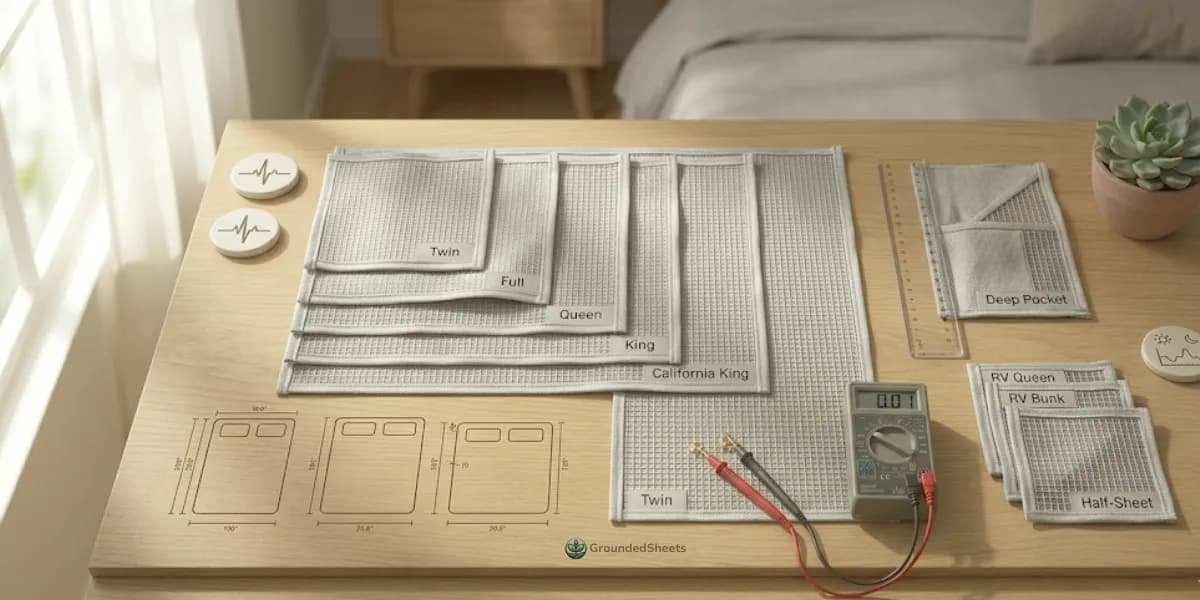
Picking the right grounding sheet size is mostly straightforward, with about three places where people get tripped up. Standard mattress sizes match standard sheet sizes. The complications come from non-standard mattresses, deep pillow tops, mattress toppers, and the gap between Eastern and California king dimensions.
This guide walks through every common bed size, what to know about fit, and the specific cases where you'd pick a non-obvious size for your situation.
Standard mattress dimensions
In the US market, here are the standard sizes you'll encounter.
Twin measures 38x75 inches. Most common in kids' rooms, single-adult bedrooms in small spaces, and bunk beds.
Twin XL measures 38x80 inches. Standard in college dorms. Also one half of a split king setup.
Full (sometimes called "double") measures 54x75 inches. The middle ground between twin and queen, less common than it used to be.
Queen measures 60x80 inches. The most common adult mattress size in the US.
King (also called "Eastern king") measures 76x80 inches. The most common large bed.
California king (sometimes "Western king") measures 72x84 inches. Narrower but longer than a standard king.
Split king is two twin XL mattresses (38x80 each) pushed together, totaling 76x80 inches. Same external dimensions as a king but with a split down the middle for adjustable bases or partner mattress preference differences.
These are the sizes every reputable grounding sheet brand offers. If you have a standard mattress in any of these sizes, picking the right grounding sheet size is just matching the label.
Where size selection gets complicated
Three things complicate the simple match-the-label approach.
Mattress depth. Standard fitted sheets are designed for mattresses 9-14 inches deep. Modern memory foam and hybrid mattresses often run 14-18 inches deep, with some premium options exceeding 18 inches. A standard fitted sheet on a too-deep mattress slides off the corners during the night. Deep-pocket fitted sheets, which several brands make in standard mattress sizes, accommodate up to 18 inches.
Pillow tops and built-in toppers. A mattress with a pillow top adds 2-4 inches to the effective depth. A 12-inch base mattress with a 3-inch built-in topper measures about 15 inches total. Match the sheet to the total depth, not just the base mattress depth.
Added toppers. If you've added a separate topper (gel, latex, memory foam) to your existing mattress, that topper adds depth and the grounding sheet has to fit around the combined stack. Plus, if the topper is non-conductive (which most are), the sheet must go on top of the topper, not under it, to maintain skin contact with the conductive surface.
For these complications, the key information you need before ordering is your total mattress stack depth measured from the bottom seam to the top surface. Take a tape measure and check rather than assuming.
Quick fit guide by mattress size
Twin (38x75): Order a twin grounding sheet. Most brands offer this.
Twin XL (38x80): Order a twin XL specifically, not a regular twin. The 5-inch length difference matters. If your brand only offers regular twin, the sheet won't fit properly at the head or foot.
Full (54x75): Order a full or double grounding sheet. Less common than other sizes but most major brands offer it. If your brand doesn't, a queen sheet can be used loosely tucked but you'll have excess fabric.
Queen (60x80): Order a queen. Most universally available size in grounding products.
King (Eastern king, 76x80): Order a king specifically. Verify the brand's "king" matches Eastern dimensions. Some smaller brands only make California king and label it generically.
California king (72x84): Order a California king specifically. Standard kings are 4 inches wider but 4 inches shorter at the foot than Cal king. A standard king sheet won't reach the head and foot of a Cal king bed properly.
Split king (76x80 total, two 38x80 sides): Order two twin XL grounding sheets. There's no such thing as a "split king grounding sheet" because the split point requires two separate cords, two separate sheets. best grounding sheets for couples and split beds
Deep pocket considerations
For mattresses thicker than 14 inches, you need a deep-pocket grounding sheet. Several brands make these.
Earth & Moon's deep pocket line fits up to 18 inches. GroundLuxe offers deep pocket queens and kings. Earthing.com has deep-pocket Premium Sheets. Hooga's deep-pocket fitted sheet line covers up to 16 inches.
The premium for a deep pocket sheet over a standard depth sheet is usually $20-50, depending on brand and size. Worth paying if your mattress requires it. A standard sheet on a deep mattress fits poorly enough to cause real problems with grounding effectiveness (corners pop off, sheet shifts, contact becomes unreliable).
Before ordering a deep pocket option, measure your mattress depth specifically. Don't assume "memory foam = deep pocket needed." Some memory foam mattresses are 12 inches deep and standard sheets fit fine. Some are 18 inches and need the deep pocket option. Measure rather than assume.
Half-sheet sizing
Half-sheets are an underrated alternative for people who don't want or need full mattress coverage.
A half-sheet is typically about 36 inches wide and the full length of your mattress. So for a queen, the half-sheet is roughly 36x80 inches. For a king, 36x80 also (since king mattresses are the same length as queen). For a Cal king, 36x84 inches. For a twin, 36x75 inches.
The half-sheet covers approximately the upper half of the mattress, where your torso rests. Your legs and feet lie below the conductive area on regular bedding. Some users prefer this configuration because the cord routes off the side at torso level rather than at the corner of the bed, and because the half-sheet sits on top of your existing fitted sheet without replacing it.
For couples where one partner wants grounding and the other doesn't, a half-sheet on the interested partner's side works particularly well. The width covers a single side of a queen or king bed, leaving the other side untouched. fitted vs flat vs half-sheet
Pillowcase sizing
Standard pillowcases come in three sizes, mostly aligned with pillow sizes.
Standard pillowcase fits standard or queen pillows, typically 20x26 inches.
King pillowcase fits king pillows, typically 20x36 inches.
Euro/square pillowcase fits 26x26 inch decorative pillows. Some grounding brands make these, most don't.
For grounding pillowcases, match the case to your pillow size. A standard case on a king pillow won't fully cover the pillow, leaving uncovered areas where there's no grounding contact. A king case on a standard pillow will be loose and bunch up.
Most grounding brands offer at least standard and king pillowcase sizes. Euro size is rare in the grounding category. grounding pillowcases: worth it or skip
Mat sizing reference
For grounding mats, sizing is less standardized but breaks into rough categories.
Small mats are typically 8x27 to 12x36 inches. Designed for under-desk foot use or small work surfaces. Cheapest tier of mats.
Medium mats are typically 24x36 to 27x40 inches. Most versatile size, works for chair seats, couches, foot use, or small bed coverage.
Large mats are typically 36x60 inches and up. Functions more like a small grounding rug, covering the floor in front of a couch or under a desk plus chair combination.
For someone unsure what they'll use the mat for, a medium size is the safest first purchase. It accommodates the most use cases and isn't dramatically more expensive than a small mat. grounding mats
Special situations
RV mattresses sometimes have unusual sizes that don't match residential standards. Common RV-specific sizes include "RV queen" (60x75 inches, also sold as "RV short queen" to distinguish it from a full-length 60x80 RV queen) and "RV king" (72x80 inches). A few brands make grounding sheets in these sizes. If yours doesn't, a regular queen or king sheet usually fits with some excess fabric.
Custom mattresses require custom sheets. Some grounding brands will make custom-sized sheets on request. This typically adds $30-60 to the price and 2-4 weeks to delivery.
Daybeds and sleeper sofas vary widely in mattress size. Measure carefully and match to the closest standard. A twin sheet often works for daybed mattresses since most daybed mattresses are twin-sized.
Bunk beds typically use twin or twin XL mattresses. Two grounding sheets are needed for a bunk bed, one per mattress. The cord routing for upper bunks can be awkward; some users mount a cord guide along the bunk frame.
Find the right size, then the right brand
Once you know your size, see which brands we rate best. Most publish clear dimensions and deep-pocket options.
See Our Top Picks →
A simple sequence for picking the right size
Measure your mattress: width, length, and depth. Write these numbers down.
Match the width and length to a standard size category. Most fall cleanly into twin, twin XL, full, queen, king, or Cal king.
Compare your measured depth to the sheet's published depth rating. If your depth is 14 inches or less, standard fitted works. If it's 14-18 inches, get a deep pocket option. If it's over 18 inches, only certain brands fit and you'll need to verify each one.
Order the matching size from a brand that publishes specs. If the brand doesn't list dimensions clearly, that's a red flag.
Verify fit on first installation. The sheet should hug the corners snugly, lie flat across the surface without stretching, and accommodate the mattress without bunching or popping off. If it doesn't, the size is wrong and most reputable brands will exchange.
For most people, this is a five-minute decision. Match your mattress to the catalog size and move on. The 20% of cases that complicate this (deep mattresses, non-standard sizes, custom configurations) are the ones worth spending real time on.