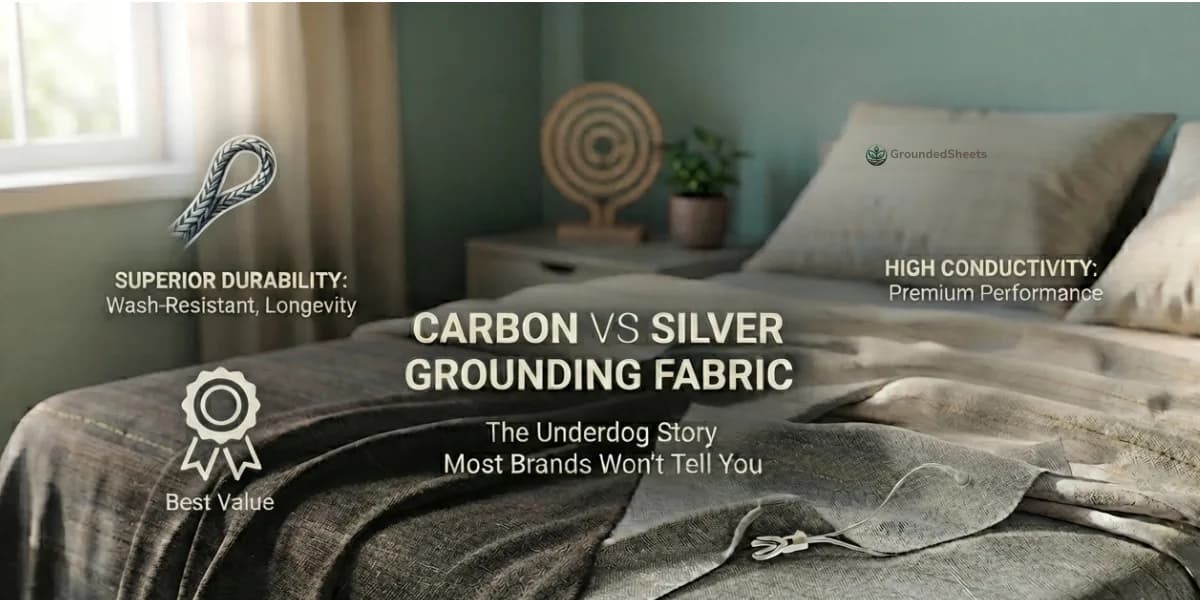
A few years ago, every grounding sheet on the market was either silver or stainless steel. Carbon-based grounding fabric was a niche material used mostly in industrial ESD applications, not consumer bedding. That's changed. Carbon-fiber grounding products are now mainstream, prices have dropped, and the durability is genuinely impressive.
| Property |
Carbon-based |
Silver fiber |
| Conductivity | Good | Highest |
| Durability | Non-tarnishing | Ages with washing |
| Lifespan | Very long | 1-3 years typical |
| Format | Usually mats/covers | Usually sheets |
| Cost | Mid-to-premium | Varies by % |
| Best for | Durability, no tarnish | Conductivity, softness |
Most affiliate sites still treat silver as the default and carbon as the budget alternative. I think that framing is outdated. Carbon-fiber grounding fabric is a serious contender now, and depending on what you're looking for, it might actually be the better choice. Let me walk through the comparison honestly.
What carbon-based grounding fabric actually is
When brands say "carbon-fiber" or "carbon-based" grounding fabric, they're usually describing one of two things. Sometimes it's a polyester or nylon fabric impregnated with conductive carbon particles. Sometimes it's a cotton or blend fabric woven with thin carbon-coated synthetic threads.
Either way, the conductive element is carbon (usually a form of graphite or amorphous carbon) rather than a metal. Carbon conducts electricity moderately well, doesn't tarnish, doesn't corrode, and costs significantly less than silver per equivalent unit of conductivity.
The fabric itself looks similar to silver-fiber bedding at a glance, though it often has a slightly grayer or more uniform tone since there's no metallic sheen from the silver content. Modern carbon grounding fabrics have improved a lot in the last few years and now feel reasonably close to cotton in hand and drape, though they're not quite identical.
Conductivity, where silver still wins on paper
Silver is one of the most conductive materials in existence. Carbon, in any of the forms used in fabric, conducts much less efficiently than silver per fiber. The bulk conductivity gap is large. A new silver-fiber sheet might measure 2 to 4 ohms across the surface. A new carbon-based sheet often measures 8 to 20 ohms.
Here's the part that matters: both ranges are within the functional range for grounding. Your body voltage drops to near zero in either case. The lower starting resistance of silver doesn't translate into meaningfully better grounding performance for the user. The system has enough resistance margin that the difference between 4 ohms and 15 ohms is invisible in practice.
I've measured both materials side by side. The body voltage drop when sitting on either type of sheet is essentially identical, going from 1-3 volts down to under 0.1 volts within a second of skin contact. The silver sheet does it through a path of less resistance, but you can't tell the difference unless you're looking at a multimeter.
So yes, silver wins on paper conductivity. Whether you can perceive that win in actual use is questionable.
Durability, where carbon pulls ahead unexpectedly
Silver tarnishes. The oxidation of silver fibers over months and years of washing and skin contact slowly increases resistance and shortens functional lifespan. A typical silver sheet is functionally done at 24 to 30 months even with good care.
Carbon doesn't tarnish. It doesn't oxidize in any meaningful way under normal use conditions. A carbon-based grounding sheet's resistance stays roughly stable across the product's life, with the main wear coming from physical abrasion of the conductive layer rather than chemical degradation.
This is the part that's underappreciated. A carbon grounding sheet often lasts 30 to 48 months even with regular washing. The sheet doesn't get less effective over time the way silver does. It just eventually wears out from physical use, which happens to all bedding regardless of conductive material.
For someone calculating cost per month of use, this is a significant factor. A $90 carbon sheet that lasts 40 months is $2.25 per month. A $200 silver sheet that lasts 28 months is $7.14 per month. That's a meaningful gap, and it goes the opposite direction from what brand marketing typically implies.
The feel-and-comfort question
This is where silver still has a real advantage.
Silver-fiber cotton sheets feel like premium cotton bedding. The silver content is low enough that you don't perceive the metal directly, and the cotton dominates the tactile experience.
Carbon grounding fabrics, especially older formulations, sometimes have a faint plasticky or synthetic texture that's perceptible against bare skin. The newer carbon fabrics are dramatically better than what existed five years ago, but they're still not quite identical to pure cotton in hand. Some people don't notice the difference. Some people notice it but don't care. Some people specifically dislike it.
The honest framing is: if you specifically prioritize the luxury feel of premium cotton bedding, silver is more likely to deliver that. If you're agnostic about the feel and just want a functional grounding sheet, carbon is fine. The difference is real but not large, and the gap has been closing rapidly as carbon-fabric technology improves.
The antimicrobial question
Silver has natural antimicrobial properties due to its ion chemistry. This is real biology and worth knowing about. Silver-fiber sheets are slightly more bacteria-resistant than other fabrics under normal use.
Carbon doesn't have antimicrobial properties. It's electrically conductive but biologically inert.
For bedding specifically, this matters less than it sounds. Both fabric types get washed regularly. Both stay reasonably clean with normal care. The antimicrobial property of silver provides a small margin of additional cleanliness that doesn't translate into a meaningful health difference for typical home use.
In medical or athletic contexts where bacteria control matters more, the silver advantage is more significant. For your bedroom, it's a footnote.
The price reality
Carbon-based grounding sheets are typically 30% to 50% cheaper than silver-fiber equivalents. A queen-size silver-fiber sheet from a reputable brand often runs $150 to $250. A comparable carbon-based sheet is usually $80 to $130.
Combined with the longer durability, the cost-of-ownership math is significantly in carbon's favor. You're paying less upfront, the sheet lasts longer, and the total cost per month of useful life is often less than half what silver works out to.
The reason silver remains popular despite this isn't because it's a better value. It's because silver has the brand cachet and the longer market history, and brands marketing to wellness-conscious buyers can charge more for it. The pricing reflects perceived premium status as much as actual material differences.
Maintenance differences
Silver requires careful washing. Bleach destroys it. Fabric softener coats it and kills conductivity. Hot water accelerates tarnish. The maintenance protocol is specific and unforgiving.
Carbon is much more forgiving. Hot water doesn't degrade it meaningfully. Most detergents don't damage it. Even fabric softener doesn't kill the conductivity the way it does with silver. You should still avoid bleach because the cotton matrix matters, but the margin for error is wider.
If you're someone who tends to forget bedding care instructions or who shares laundry duty with someone who does, carbon's forgiving nature is a real practical advantage. how to wash grounding sheets
When silver is still the right call
Silver-fiber sheets are the better choice if you specifically value premium cotton feel above other considerations, if you want the antimicrobial property for medical or athletic reasons, if you're willing to pay the premium for the brand history and the slight conductivity edge, or if you're simply someone who likes silver as a material and finds the wellness story compelling.
These are real reasons. They just aren't reasons of pure performance. The silver versus carbon choice has become more about preference and brand identity than about which one works better at the actual job.
When carbon is the better call
Carbon is the better choice if you want the lowest cost per month of useful life, if you wash your bedding aggressively or in a household where laundry standards aren't carefully controlled, if you don't notice the slight feel difference between cotton-with-silver and cotton-with-carbon, or if you're suspicious of the markup that silver products command without proportional functional benefit.
For a buyer who isn't already invested in the silver wellness aesthetic, carbon offers most of the function at a fraction of the price with longer lifespan. It's genuinely a better practical buy for many people.
My actual recommendation
If you're a first-time grounding product buyer with no particular preference between materials, I'd suggest carbon. The cost-of-ownership math is meaningfully better, the durability is impressive, the feel is acceptable for almost everyone, and you can always upgrade to silver later if you decide you want premium cotton feel.
If you're already committed to the wellness aesthetic and want the silver experience, silver is fine and has its real benefits. Just understand you're paying a premium that's partly justified by feel and antimicrobial properties and partly justified by brand positioning that may or may not match your priorities.
The carbon-versus-silver debate is genuinely closer than the marketing suggests. Silver is the legacy choice. Carbon is, increasingly, the smart choice. Both work. Pick based on what you actually care about, not based on which one the brands have positioned as premium.